LOCATION

Ontario, Canada

SIZE

71,140 ha

STAGE

Grassroots

DEPOSIT TYPE(S)

Orogenic Au, VMS, Magmatic Ni-Cu

The Western Wabigoon Project is a 71,140 hectare, district-scale greenfields exploration Project located in northwestern Ontario. The property represents an opportunity for grassroots discovery over a large area of converging deformation zones within a prospective greenstone belt. The Project is well situated, close to infrastructure and in a favourable jurisdiction. On June 25, 2025, the Western Wabigoon Project was optioned to Centerra Gold Inc. under an earn-in agreement, whereby Centerra may acquire up to a 70% interest in the Western Wabigoon Project.

Location and Access

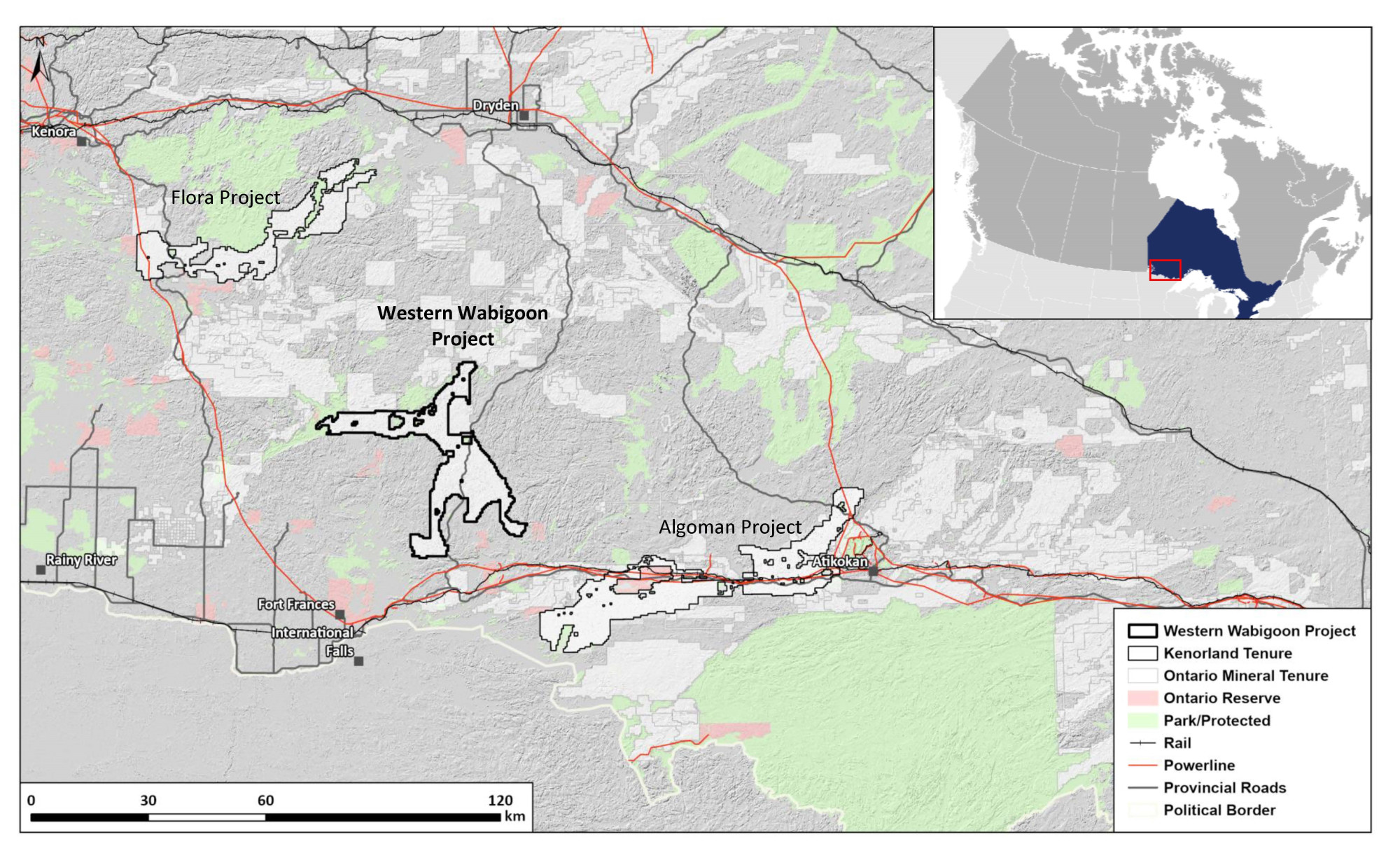
The Western Wabigoon Project is located within the Rainy River District of Western Ontario and the center of the property is located 40 km to the northeast of the town of Fort Frances and 80km east of the town of Rainy River. The Project is intersected by provincial highway 502, and contains an extensive network of forestry roads. Rail and transmission lines are within 15km of the Project’s southern boundary, and a separate transmission line is 26km from the western boundary.

Geology and Mineralisation

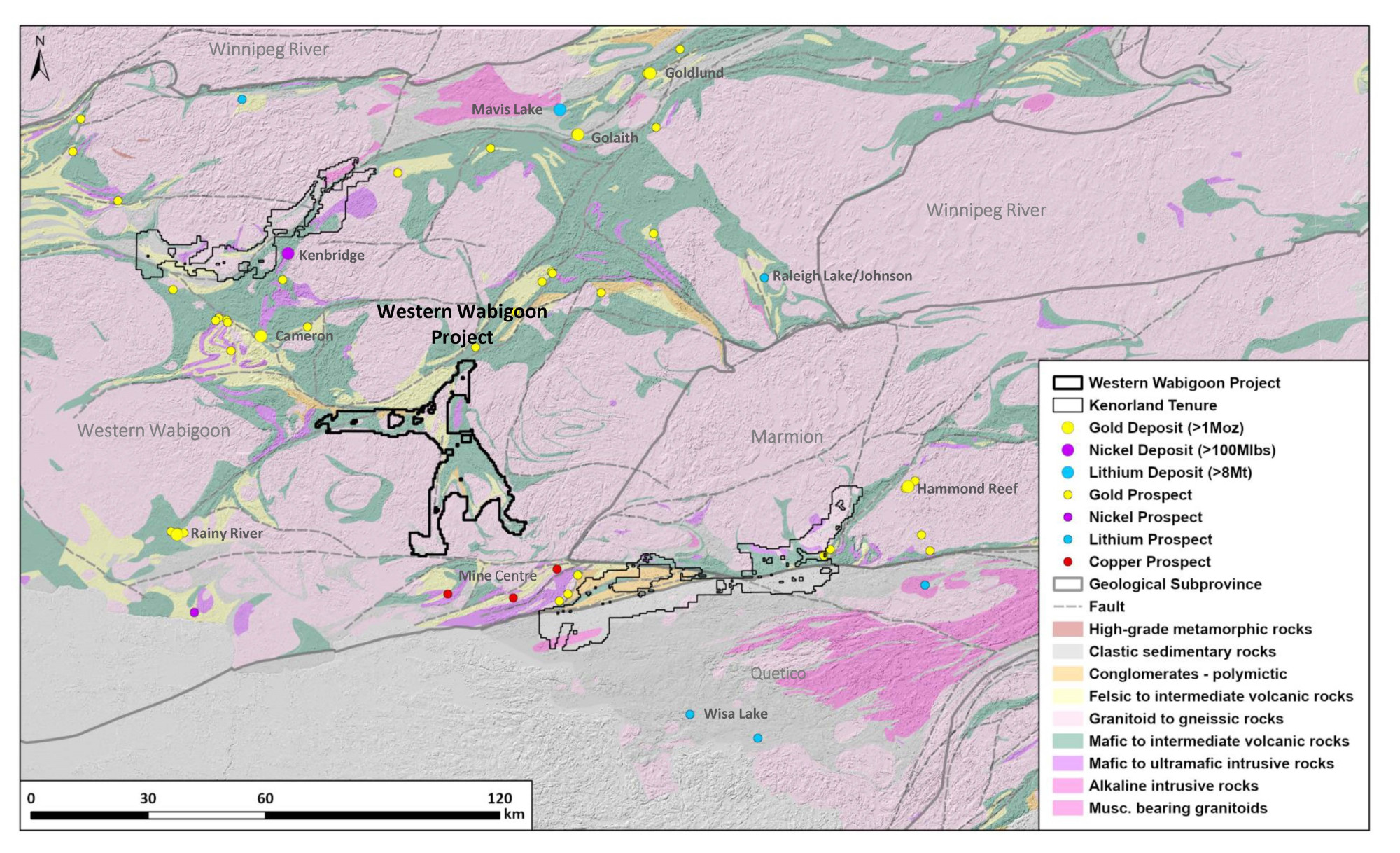
The property is situated at the western end of the Wabigoon Subprovince of the Archean Superior Province. The geology of the property is dominated by an extensive greenstone belt of mafic and lesser felsic to intermediate metavolcanic and metasedimentary rocks which have been metamorphosed to greenschist to amphibolite grades.

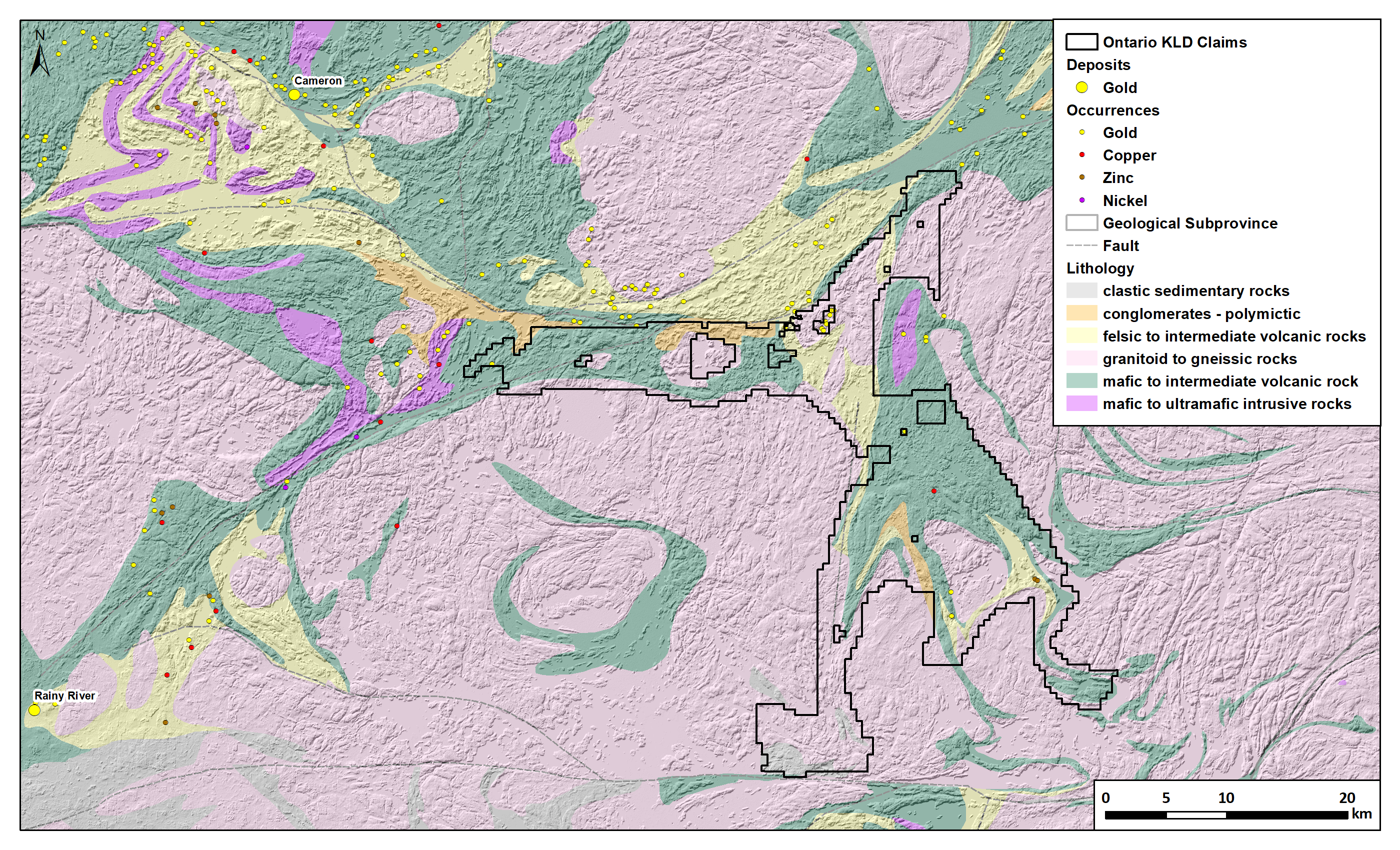
Within the northern portion of the Project is an intersection of the major Pipestone-Cameron Deformation Zone (PCDZ), Pipestone-Manitou Straits Deformation Zone (PMDZ), and the Helena-Pipestone Deformation Zone (HPDZ).  The PCDZ hosts the Cameron orogenic Au deposit to the northwest of the property, and the HPDZ hosts the Rainy River deposit 55 km to the southwest. These fault zones host a number of additional gold showings and deposits, usually associated iron carbonate veins, altered shear zones and porphyry dykes. The southern handle of greenstone belt has seen very little exploration maturity and hosts gabbroic sills, porphyry dykes, VMS-style zinc occurrences and pegmatite dykes. Several base metal VMS occurrences occur within the southern portion of the Project, and anomalous Li, Cs and Rb in lake sediment geochemistry are spatially coincident with pegmatite dykes noted in regional mapping.

Exploration History

Although the area has seen exploration dating back to the 1930’s, the most significant exploration conducted has been targeting base metal potential in the 1970’s. A total of 123 diamond drill holes are within the Project boundaries. Lake sediment, soil MMI, and prospecting program was carried out along the northern boundary of the Project in 2011 to explore the orogenic potential. Since then, no systematic geochemical surveys or detailed geophysical surveys have been performed.

Summary of exploration activities conducted by Kenorland Minerals

Since staking of the Project in April 2023, Kenorland has completed the compilation and digitization of historical exploration data within the Project area. A LIDAR survey was flown by Kenorland in the summer of 2023 to aid in surficial geological interpretation and planning of systematic geochemical surveys.

During the summer 2024 field season, systematic, geochemical screening of the Western Wabigoon Project included the collection of approximately 2,820 till samples (1000 m x 200 m sample spacing) covering the property. A significant, approximately 19 km trend of gold-in-till anomalism follows the southwest-northeast trending Manitou-Dinorwic Deformation Zone (MDdz) that transects the northern portion of the property. Within that trend, the W1 target (see figure in Gallery Section) is defined by continuous high tenor gold-in-till results, with Au-As±Sb-Te-W metal associations. A second zone of strong geochemical anomalism, located 6 km along strike to the southwest, the W2 target (Au-As-Sb), is concentrated where the MDdz orientation changes from a southwest-northeast trend to east-west. The W3 target (Ag-Mo-Te-W±Au-Cu), located 5 km to the southeast follows a regional contact between mafic volcanic rocks and gabbro intrusive rocks. 

In 2025, infill till sampling further refined multiple coherent, high-tenor gold-in-till anomalies across the W1, W2, and W3 target areas. At W2, heavy mineral concentrate HMC analysis returned normalized gold grain counts of up to 251 grains per sample along a 4 km trend, reinforcing its significance as a priority for 2026 follow-up, including diamond drilling. Surface work has confirmed gold mineralisation along the historical Sorry Mac trend—now part of the W2 target—with rock samples up to 7.75 g/t Au and a significantly expanded footprint.

Planning for the 2026 field campaign is under way with up to 5,000m of diamond drilling proposed, designed as a series of fences to test key structural intersections associated with strong gold-in-till and gold grain anomalies, focusing on the priority W2 target of the Western Wabigoon Project.

See All Projects